
FB

Express Packing

Holding Tank Crating Case Study | Express Packing

How Express Packing Eliminated Recurring Shipping Damage on Industrial Holding Tanks

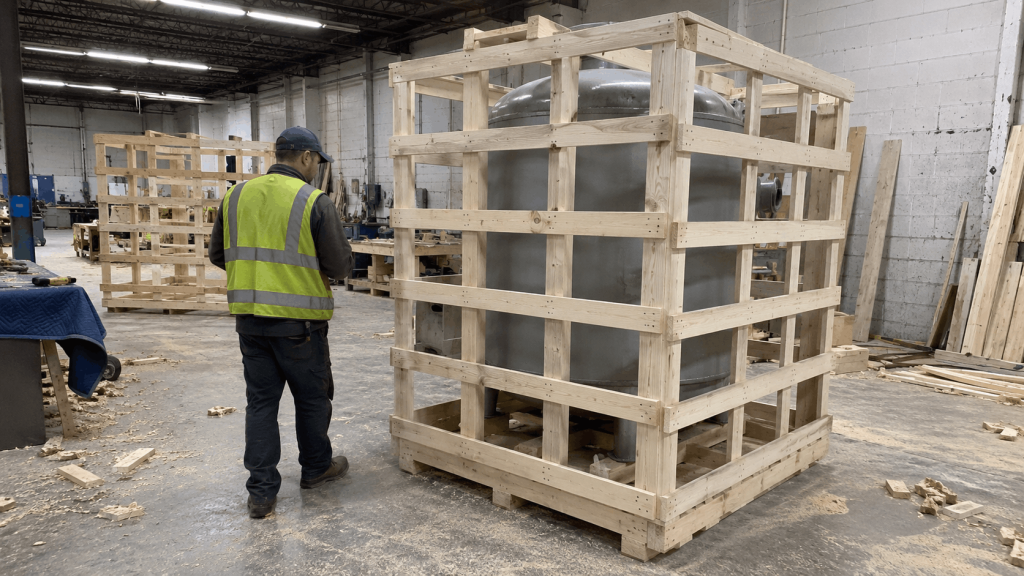
A custom bird-cage wood crate built around an industrial holding tank on a properly sized base skid, demonstrating Express Packing's holding tank crating and damage prevention approach.

When the same product gets damaged shipment after shipment, the instinct is to blame the carrier. But in most recurring damage cases, the real problem is the packaging. This is exactly what one manufacturing customer discovered when they brought their holding tank crating challenge to Express Packing.

— The Challenge

The Hidden Cost of "Saving" on Freight Dimensions

The customer was shipping holding tanks two units at a time, side by side, to stay within freight dimensions that qualified for a lower shipping rate. The logic made sense on paper: smaller declared dimensions equal lower freight cost.

The problem was that this configuration didn’t give each tank adequate protection. The side-by-side arrangement left both units vulnerable to shifting, contact damage, and inadequate support during transit. Damage kept occurring on delivery, triggering claims, replacement costs, and frustrated end customers.

This is a pattern Express Packing sees regularly. In industrial freight, dimensional pricing can push shippers to minimize the footprint of their shipments. But when that decision forces two products into a shared configuration that wasn’t engineered for the actual load, the savings on the freight invoice get wiped out by what shows up on the damage report.

— The Express Packing Solution

The Express Packing Assessment

Rather than simply quoting a replacement crate, Express Packing took a consultative approach. Our team worked directly with the customer to explain how shipping dimensions, freight pricing, and packaging protection are connected.

The conversation centered on a direct question: was the money saved on the lower freight rate actually being saved, once damage claims and replacement costs were factored in? In this case, the answer was no.

This kind of analysis is part of how Express Packing approaches packaging problems. We don’t look at a crate in isolation. We look at the full picture: how the product is handled at origin, how it moves on the truck, where force is applied during loading and unloading, and whether the current blocking and bracing is adequate for the load. In this case, it wasn’t.

Redesigning the Packaging Around Two Key Changes

Express Packing redesigned the custom packaging around two specific changes.

Change 1: Bird-Cage Each Tank

Each holding tank was bird-caged. Bird-caging is a protective framing technique that surrounds a product with a structural cage, preventing direct contact with other surfaces and absorbing impact during transit. It is commonly used for irregularly shaped, high-value, or fragile industrial products that cannot tolerate contact damage.

By bird-caging each tank individually, Express Packing ensured that no tank was ever in direct contact with another unit or an unsupported surface during the entire transit cycle.

Change 2: Build a Solid Base Skid Sized for Each Individual Unit

The second change was building a solid base skid correctly sized for each tank as a standalone unit, rather than a shared configuration designed for two side-by-side.

A properly sized base skid does three things: it distributes the tank’s weight evenly across the floor of the trailer, it provides a stable platform for forklift handling at both origin and destination, and it eliminates the load shifting that comes from a skid that’s too wide or too narrow for the product it’s carrying.

The tradeoff was that shipping two tanks this way required more freight space than the original side-by-side configuration. The freight cost went up slightly. But the damage stopped.

— The Express Packing Solution

Zero Damage, Consistent Deliveries

After the redesign, shipping damage was eliminated. The customer now receives consistent, reliable deliveries without the recurring cycle of claims, replacements, and disruption.

The slight increase in freight cost was offset many times over by the elimination of damage claims, the time no longer spent managing insurance disputes, and the improved experience for end customers.

This is the core value of engineering-first packaging. A crate is not just a box. It is a system designed to protect a specific product through a specific transit cycle. When that system is designed correctly, the product arrives intact every time.

What This Means for Your Operation

If your team is experiencing recurring damage on the same product, the packaging design is almost certainly the issue. Carriers get blamed most often, but damage that happens consistently on the same SKU points to something structural: a gap in protection, a load that shifts in the same spot every time, or a configuration that was optimized for cost instead of safety.

Common warning signs that a packaging redesign is needed:

  • Damage appearing in the same location on the product across multiple shipments
  • A side-by-side or multi-unit configuration that was chosen to reduce freight dimensions
  • Damage rates above industry norms on specific products
  • Recurring claims against the same carrier for the same product

The question isn’t whether better packaging costs more. It almost always costs slightly more up front. The question is whether the recurring damage is costing more than the packaging fix would.

At Express Packing, we have over 50 years of experience diagnosing and solving exactly these kinds of packaging problems. Our team can evaluate your current setup, identify where the design is failing, and build a solution that actually stops the damage.

FAQ

Frequently Asked Questions

What is bird-caging and when is it used in industrial shipping?

Bird-caging is a protective framing technique that builds a structural cage around a product to prevent direct surface contact and absorb impact during transit. It is most commonly used for irregularly shaped products, tanks and vessels with external components, and high-value items that cannot tolerate contact damage during shipping.

We walk customers through the full cost picture: freight rates, damage claim rates, replacement costs, and operational disruption. In most cases, the increase in packaging cost is quickly offset by the elimination of damage claims. We explain the tradeoffs clearly so customers can make informed decisions.

Yes. Packaging redesign is a core part of what we do. If you are experiencing recurring damage, our team can evaluate your current packaging, identify the failure point, and build a new solution. We work with your existing product dimensions and transit requirements.

Any heavy, awkward, or irregularly shaped product benefits from a properly sized base skid. This includes industrial tanks, heavy machinery components, electrical equipment, and any product where load stability during forklift handling is critical. A skid sized for the actual product prevents tipping, shifting, and off-center loading.

Freight classification and dimensional pricing are based on the declared dimensions of the shipment. Larger crates generally mean higher freight costs. However, crates that are too small or too tight for the product create the damage risk this case study describes. The right answer is a crate sized correctly for the product, with an honest understanding of what that means for freight cost versus protection.

Experiencing recurring damage on the same product?
Express Packing can find the fix.